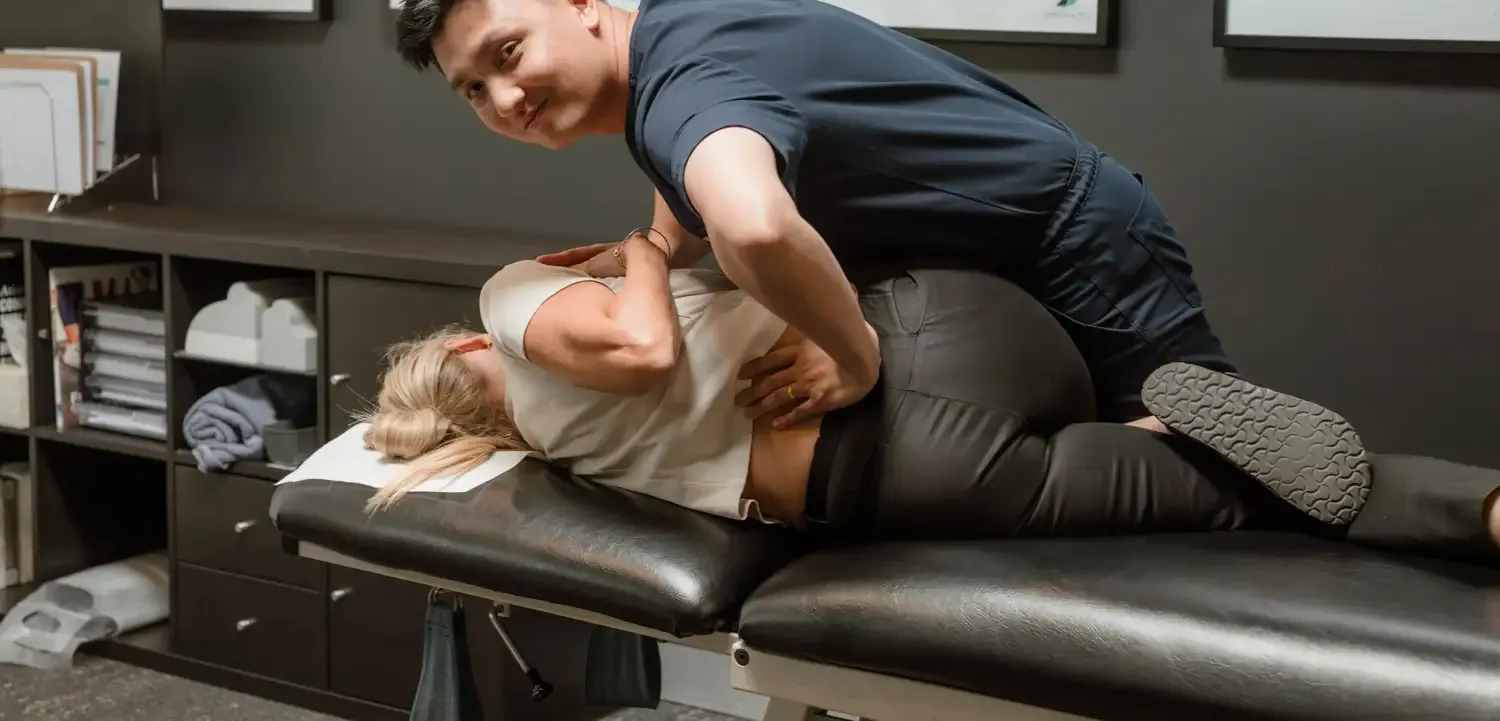
Short answer: When a chiropractor cracks your back, they move a stiff spinal joint quickly, a short distance, just past where it normally stops. That fast stretch drops the pressure inside the joint fluid and a gas bubble forms, which makes the pop. Nothing breaks, slips or clicks back into place, and the sound isn't the point.
What's making the chiropractor cracking sound?
Your spine has small paired joints at the back of each vertebra called facet joints. Like your knuckles, each one is wrapped in a capsule and filled with a slippery joint fluid. That fluid holds dissolved gases, much like a sealed bottle of soft drink.
When a chiropractor cracks your back, the quick movement separates the joint surfaces slightly. The space inside the capsule increases faster than fluid can flow in, the pressure drops, and gas comes out of solution to form a bubble. That rapid event is called cavitation, and it's what you hear. Imaging research using real-time MRI has filmed this happening in knuckle joints, and it matches the pop people hear in the spine.
A few things follow from that:
- It isn't bones cracking. Bones aren't rubbing, grinding or breaking.
- It isn't a vertebra going back into place. Spinal joints move a few millimetres during an adjustment. They don't pop in and out.
- The same joint usually won't pop again straight away. The gas takes time to dissolve back into the fluid, which is why you can't re-crack a knuckle immediately.
- Several pops can happen at once because neighbouring joints are often moved together.
Why do chiropractors crack your back?
The goal isn't the noise. The goal is movement. A chiropractor adjusts a joint that their check has found to be stiff, sore or not moving well, to help it move more freely and feel more comfortable. The research suggests several things happen together when a joint is adjusted:
- The joint capsule and surrounding tissues get a brief, quick stretch.
- Nearby muscles that are guarding or tight often relax for a while afterwards.
- The nervous system's sensitivity to pain in that area may settle in the short term.
- Movement that felt blocked often feels easier, which makes it easier to stay active.
Clinical guidelines for low back pain include spinal manipulation among the options, alongside exercise and staying active. That's how we use it: as one part of a plan, not as a stand-alone treatment. For a full walk-through of the technique, see what actually happens in a chiropractic adjustment.
Is the crack a sign it worked?
No. This is the biggest myth about back cracking. Research comparing adjustments that did and didn't produce a sound suggests people tend to feel similar changes either way. Some joints pop easily, some rarely do, and that varies from person to person and day to day. A good chiropractor doesn't chase the sound, and doesn't keep repeating an adjustment just to get one.
| What people think | What's actually happening |
|---|---|
| Bones are cracking | A gas bubble is forming in the joint fluid |
| A vertebra was "out" and went back in | A stiff joint was moved a small, controlled distance |
| A louder crack means a better result | The sound doesn't predict how you'll feel |
| No crack means it didn't work | The joint can move better without any noise |
| Cracking releases toxins | There's no evidence of this; soreness afterwards is normal tissue response |
| The pop is the whole effect | The quick stretch also sends a burst of sensory input to your nervous system |
If the crack isn't the point, what is? Your nervous system
The part of a back adjustment that matters may be the part you can't hear. The deep muscles and tissues around your spinal joints are packed with sensors that report position and movement to your brain. The quick stretch of an adjustment fires those sensors together, sending a burst of fresh information to the brain about a segment it may not have been sensing or controlling well. That's the modern way researchers describe a vertebral subluxation and what an adjustment does about it1.
Researchers are now studying what the brain does with that input. In one study of 15 people with mild, recurring spinal pain, the brain didn't show its usual habituation to a cold-water pain test after an adjustment, suggesting adjustments may alter how the brain processes pain2.
So the pop is a by-product, and the nervous system side is the more interesting part, with the science still developing. We cover it in chiropractic and your nervous system.
What it feels like, and what you might feel afterwards
Before adjusting your back, your chiropractor positions you, often lying on your side for the low back or face down for the mid back, then takes the joint to the end of its comfortable movement. You'll feel firm pressure, then a quick, short push lasting a fraction of a second. Most people describe it as a release or a deep stretch. It shouldn't be sharply painful, and you can ask your chiropractor to stop at any point.
Afterwards, many people feel looser. Some feel mild soreness, stiffness or tiredness for a day or two, a bit like after a workout you're not used to. That's the most common reaction and it usually settles on its own. We cover this in more detail in the side effects of chiropractic treatment and why your lower back can feel worse after an adjustment.
Cracking your own back vs a chiropractic adjustment
When you twist in your chair and get a crunch, you're producing the same kind of gas bubble. The difference is where. Self-cracking tends to move the joints that are already the loosest, because they give way first. The stiff joint that's actually bothering you often doesn't budge.
A chiropractic adjustment is aimed at a specific joint, chosen after an assessment, and delivered in a set position with a controlled amount of force. Occasional self-cracking isn't something to panic about, and studies of habitual knuckle crackers haven't linked it to arthritis. But if you feel the need to crack your back constantly, that urge is worth getting checked, because it usually means something is stiff and the relief is short-lived.
How we approach this at MPCC
At Mornington Peninsula Chiropractic we don't crack anything until we know what we're dealing with. Your first visit is a new patient appointment of 30 to 40 minutes: your story, digital posture pictures, and a thorough chiropractic, orthopaedic and neurological check of your spine, joints and nerves. If your history and check point to X-rays, we'll refer you, and the imaging clinic we refer to bulk bills X-rays our chiropractors request.
Whether you're adjusted on the first visit is up to the clinical judgement of your chiropractor. Often more testing comes first. At your report of findings appointment we explain what we found and what we'd do, in plain English. Along with hands-on adjustments, we use a flexion-distraction table, a gentle, rhythmic, table-assisted technique for low back and disc problems, plus home exercises. If you'd rather not be adjusted in a particular way, just say so.
References (2)
- Haavik H, et al. (2021). Contemporary model of vertebral column joint dysfunction. Eur J Appl Physiol. doi:10.1007/s00421-021-04727-z
- Navid MS, et al. (2019). Central processing of tonic pain after chiropractic adjustment. Sci Rep. doi:10.1038/s41598-019-42984-3