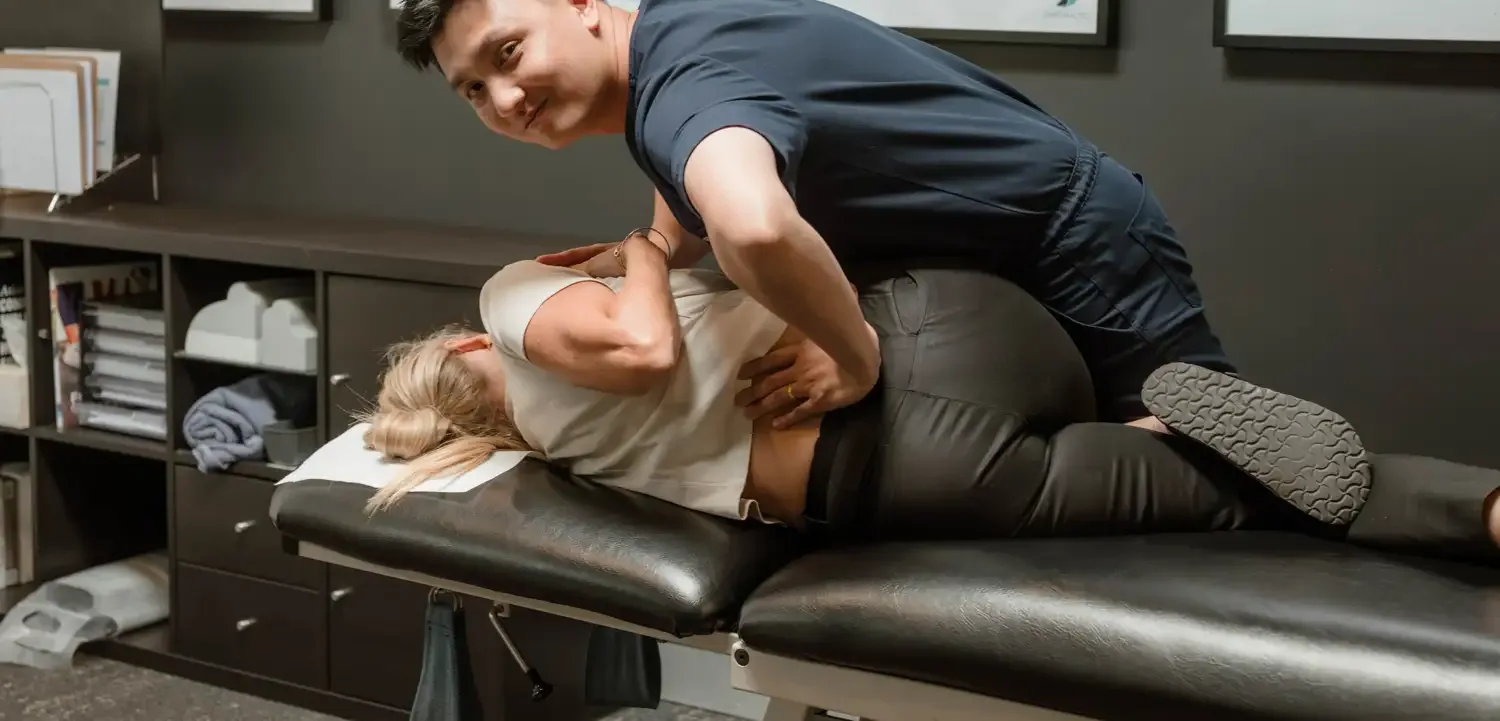
Short answer: Disc pain is assessed by combining your history, how your spine moves, orthopaedic tests and a neurological check of sensation, reflexes and strength. Together these show whether a disc is likely involved and whether a nerve is irritated. Imaging such as X-ray or MRI helps only when the findings point to it.
A quick look at the spinal disc
Between each pair of vertebrae from the neck to the low back sits an intervertebral disc. Each disc has two parts:
- The annulus fibrosus: tough outer rings of fibre, layered like the rings of an onion.
- The nucleus pulposus: a softer, gel-like centre that spreads load.
The outer part of the annulus has a nerve supply, so a disc can be a source of pain in its own right. If the inner material pushes outward, as a bulge or herniation, it can also irritate a nearby nerve root.
That gives two broad types of disc-related pain:
| Local (axial) disc pain | Nerve-related (radicular) pain | |
|---|---|---|
| Where it's felt | Deep in the low back or neck, sometimes into the buttock or shoulder blade | Travels down the leg or arm, often below the knee or into the hand |
| What it feels like | Deep, dull ache | Sharp, burning or electric; may come with pins and needles or numbness |
| Common aggravators | Sitting, bending forward, lifting | Sitting, bending, coughing, sneezing, certain neck or back positions |
| Nerve tests | Usually normal | May show changes in sensation, reflexes or strength |
How is disc pain assessed? Step 1: your history
Your story is the most useful part of the assessment. We'll ask:
- how and when it started, and whether there was a particular lift, twist or fall
- exactly where you feel it, and whether it travels into an arm or leg
- what makes it better or worse: sitting, standing, walking, bending, lying down, coughing
- whether you have pins and needles, numbness or weakness
- how it behaves overnight and first thing in the morning
- your work, sport, past injuries and general health
Patterns matter. Pain that's worse sitting and bending and eases with walking, for example, tells us something different from pain that's worse standing and leaning back.
Step 2: posture and movement
We look at how you stand and take posture pictures. Then we watch how your spine moves: bending forward and back, side bending and rotating. We note which movements reproduce your pain, whether the pain moves closer to the spine or further down the limb, and whether you shift to one side to avoid it. Feeling how each spinal level moves helps us tell disc involvement apart from facet joint or muscle problems.
Step 3: orthopaedic and neurological tests
Orthopaedic tests put specific, controlled load on structures to see which reproduce your symptoms. For the low back, these include tests such as the straight leg raise and slump test, which gently tension the nerves running into the leg. For the neck, they include tests that narrow or open the space where the nerves exit.
The neurological check looks at how the nerves are actually working:
- Sensation: light touch and sharp/dull testing over the skin areas each nerve supplies.
- Reflexes: at the knee, ankle, elbow and wrist.
- Muscle strength: specific muscles linked to each nerve root, such as lifting the big toe or straightening the elbow.
Put together, the pattern of findings usually points to which spinal level is involved and how irritated the nerve is. It also gives us a baseline to re-check against as care progresses.
Beyond the disc: how your nervous system is controlling your back
A disc is only part of the picture. Pain, injury and ongoing stress can change the brain's control of the spinal segments around a sore disc: the deep muscles tighten, the segment moves less, and the brain gets patchier information back from the area, which can keep the problem going. Chiropractors call this a vertebral subluxation; researchers describe it as a change in how the brain controls a spinal segment1. That's why our check also looks at how each level moves, not only at the disc and nerve root.
Research is beginning to look at the brain in people with long-term back pain. In a trial of 76 people with chronic low back pain, four weeks of chiropractic care was followed by changes in resting brain activity, alongside better light sleep and lower pain, anxiety and fatigue scores2. A 2026 review of 10 brain imaging studies in people with disc herniation or chronic low back pain also reported changes in brain networks after spinal manipulation3. This research is still emerging, and the mood results were secondary measures, so treat it as interesting rather than settled. More in chiropractic and your nervous system.
Step 4: when imaging helps
Scans don't tell the whole story. Plenty of people have disc bulges on MRI with no pain at all, and the picture doesn't always match the symptoms. That's why we treat the person, not the picture.
Imaging is useful when your history and check suggest it would change what we do. At MPCC, we only refer for X-rays when your history and check point to them, and the imaging clinic we refer to bulk bills X-rays our chiropractors request. X-rays show bone, alignment and disc height, but not the disc itself. If you've already had an MRI, CT or X-ray, bring the reports along. Read more in do I need an X-ray to see a chiropractor?
How we approach this at MPCC
All four steps above happen in your new patient appointment, which takes 30 to 40 minutes: your story, posture pictures, and a thorough chiropractic, orthopaedic and neurological check of your spine, joints and nerves. Whether you're adjusted on that first visit is up to the clinical judgement of your chiropractor. Often more testing comes first, sometimes X-rays.
At your report of findings appointment we explain what we found in plain English and what we'd do. For disc-related low back problems, care may include specific adjustments and work on our flexion-distraction table, a gentle, rhythmic, table-assisted technique, plus home exercises. See our disc bulge page and sciatica page for more.
References (3)
- Haavik H, et al. (2021). Contemporary model of vertebral column joint dysfunction. Eur J Appl Physiol. doi:10.1007/s00421-021-04727-z
- Haavik H, et al. (2024). Neuroplastic responses to chiropractic care. Brain Sci. doi:10.3390/brainsci14111124
- Cao L, et al. (2026). Brain functional changes after spinal manipulation: a scoping review. Front Neurol. doi:10.3389/fneur.2025.1712320