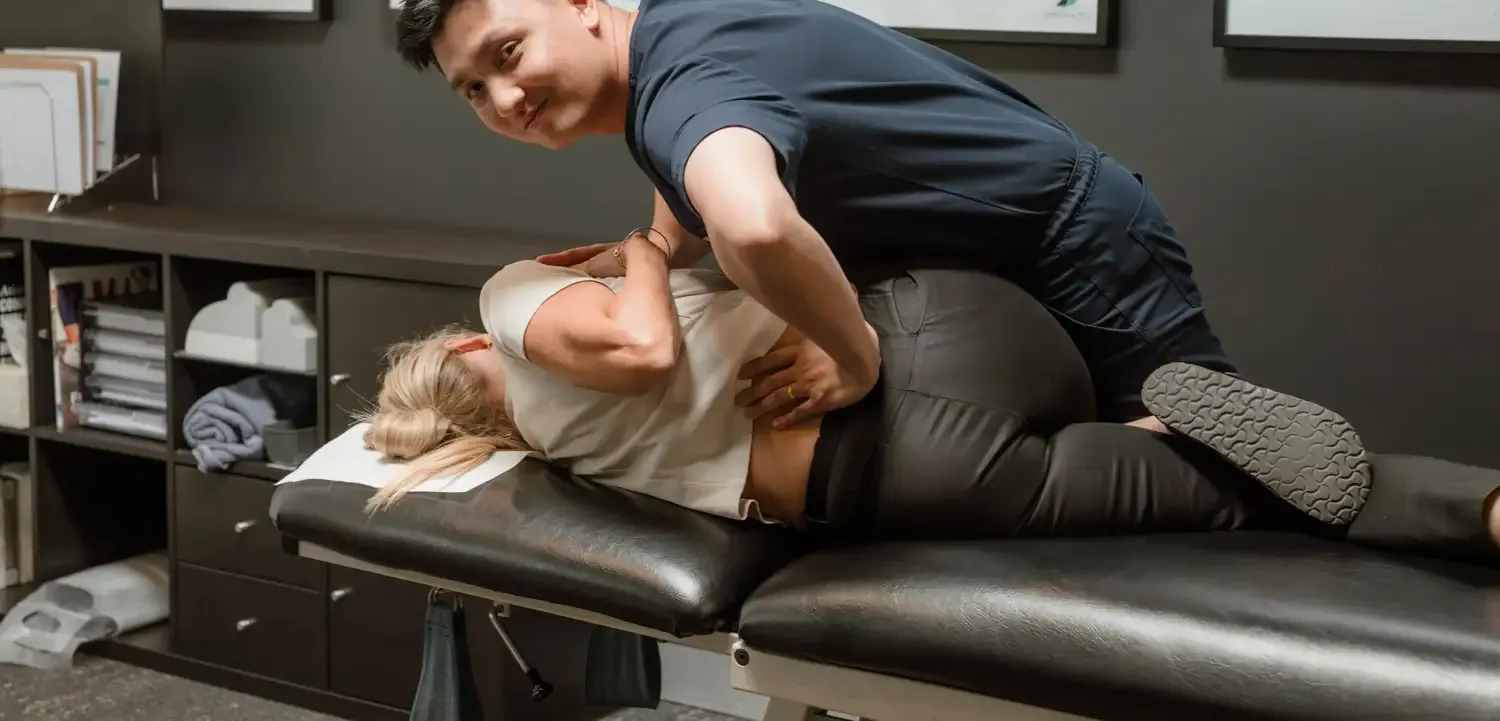
Short answer: In a chiropractic neck adjustment, you lie on your back while your chiropractor cradles your head, turns and tilts it to a set position, then applies a quick, small, controlled movement to a stiff joint in your neck. It takes a fraction of a second, often pops, and only happens after a check and with your agreement.
Before any neck adjustment: your chiropractor checks first
A neck adjustment is never the first thing that happens. Before your chiropractor adjusts your neck, they need to know whether it's appropriate for you, and which joint to work on. That means:
- Your history: how the pain started, past injuries such as whiplash, headaches, other health conditions and any medications.
- How your neck moves: turning, tilting, looking up and down, and what reproduces your pain.
- Feeling the joints: which levels are stiff or tender when pressed and moved.
- Orthopaedic and neurological tests: reflexes, strength and sensation in your arms, and tests that stress the neck in specific ways.
This screening is how your chiropractor decides whether a neck adjustment suits you at all. We go through the safety side in detail in should a chiropractor adjust your neck?
You're also in charge. You can always say no to a neck adjustment, and your chiropractor will talk you through the other options. Nobody should adjust your neck without explaining what they're doing and checking you're comfortable with it.
How a chiropractic neck adjustment is done, step by step
- Positioning. Most commonly you lie on your back with your head resting in your chiropractor's hands. Some adjustments are done seated.
- Contact. Your chiropractor places a specific part of their hand, often the side of the index finger, against the joint they want to move. The other hand supports your head.
- Setting up. They turn and tilt your head a set amount to take the joint to the end of its comfortable range. You'll feel a firm stretch. You should be relaxed, not braced.
- The adjustment. A quick, short, controlled movement through that one joint. It's not a big twist, and it's over in a fraction of a second.
- Recheck. Your chiropractor retests how your neck turns and whether the tender spot has changed.
The movement is small. The aim is a specific joint, not a general wrench of the whole neck. Watching neck cracking videos online can make it look forceful. In the room, a good adjustment feels controlled and precise.
Common types of neck adjustment and related techniques
| Technique | How it's done | What it feels like |
|---|---|---|
| Rotational adjustment | Lying on your back, head turned, quick movement into rotation | A turn and stretch, then a quick release, often a pop |
| Side-bend (lateral) adjustment | Head tilted towards one shoulder, contact on the side of the neck | Pressure on one side, then a small, quick movement |
| Seated adjustment | Sitting upright, chiropractor standing behind | Similar to the above, in a sitting position |
| Upper back adjustment | Lying face down or on your back, adjusting the joints below the neck | Pressure through the upper back; often eases neck movement too |
| Mobilisation | Slow, repeated movements of the neck joints, no quick thrust | A gentle rocking or stretching, no pop |
| Soft tissue work and exercises | Hands-on muscle work, plus home exercises | Pressure on tight muscles; active movements you do yourself |
Your chiropractor chooses based on your check, your comfort and what's appropriate on the day. The neck is rarely treated in isolation: the upper back and shoulders are often part of the picture, especially with tech neck and desk posture.
What is the pop, and does it have to happen?
The pop in a neck adjustment is the same thing that happens when you crack your knuckles. The quick movement slightly separates the joint surfaces, the pressure inside the joint fluid drops, and a gas bubble forms. That's called cavitation. It isn't bones cracking, grinding or going back into place.
The sound isn't a sign of success either. A neck adjustment can be useful with or without a pop, and a good chiropractor won't keep trying for one. Neck pops can sound loud because the joints are close to your ears, which is why a neck adjustment can sound bigger than it is.
What a neck adjustment does in your nervous system
The deep muscles of your neck are packed with sensors that tell your brain where your head sits relative to your body and how it's moving. Your brain relies on that information for things like keeping your eyes steady while your body turns. When a neck segment isn't moving or being controlled well, researchers describe the brain's control of it as altered, and a neck adjustment as a burst of fresh input that helps the brain recalibrate1.
A handful of studies have looked at what changes:
- Coordination. In a controlled trial of 39 people with recurrent neck pain, adjustments reversed an abnormal pattern in how the cerebellum and motor cortex worked together during a motor-learning task2.
- Eye–neck reflexes. In a trial of 27 people with mild, recurring neck pain, eight weeks of chiropractic care normalised the reflex that guides how the eyes track as the trunk moves, compared with no care3.
- Motor control. In 22 people with a restricted top joint of the neck, neck and limb motor control improved after upper-neck care, although that study had no comparison group4.
These are small, promising studies, not proof of long-term benefit. They do show the nervous system responds when a neck joint is adjusted. Read more in chiropractic and your nervous system.
What a neck adjustment feels like, and afterwards
Most people feel a firm stretch, then a quick release. It shouldn't be sharply painful. If you're tense, your chiropractor will usually wait, reposition or choose a different approach. Afterwards, many people notice their neck turns more easily.
The most common reactions are mild and short-lived: some soreness or stiffness in the neck, occasionally a mild headache or tiredness, usually within the first day or two and settling on their own. Gentle movement helps, and your chiropractor may give you neck exercises to do at home. And on the question people worry about most: a large 2026 study of more than 862,000 adults found no added risk of a neck artery tear after chiropractic neck care. More in our article on neck adjustment safety.
How we approach neck adjustments at MPCC
At Mornington Peninsula Chiropractic, your first visit is a new patient appointment of 30 to 40 minutes. We hear your story, take digital posture pictures and do a thorough chiropractic, orthopaedic and neurological check of your spine, joints and nerves. For neck problems, that includes the screening above. If your history and check point to X-rays, we'll refer you, and the imaging clinic we refer to bulk bills X-rays our chiropractors request.
Whether you're adjusted on the first visit is up to the clinical judgement of your chiropractor. Often more testing comes first. At your report of findings appointment we explain what we found and what we'd suggest for your neck pain or headaches, and you decide. If you have questions or concerns about having your neck adjusted, raise them. We'd rather talk it through than have you sit there unsure.
References (4)
- Haavik H, et al. (2021). Contemporary model of vertebral column joint dysfunction. Eur J Appl Physiol. doi:10.1007/s00421-021-04727-z
- Baarbé JK, et al. (2018). Cerebellum and motor cortex plasticity in neck pain. PLoS One. doi:10.1371/journal.pone.0193413
- Campbell S, et al. (2024). Cervico-ocular reflex after chiropractic care. Exp Brain Res. doi:10.1007/s00221-024-06915-7
- Ambalavanar U, et al. (2025). Neck and limb motor control after upper-neck treatment. J Integr Neurosci. doi:10.31083/JIN39548