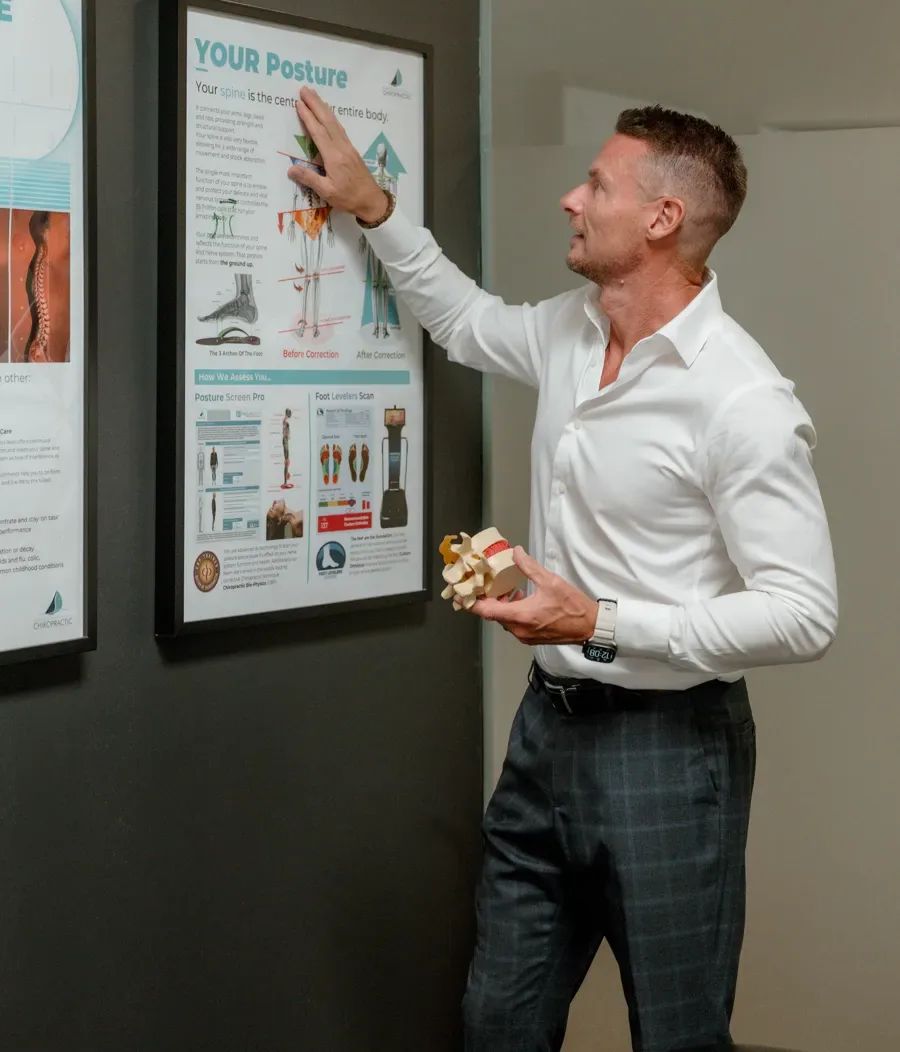
Short answer: Step 2 of how to help your back pain is to keep moving. Your spinal discs have very little direct blood supply and rely on movement to draw in fluid and nutrients. Your joints rely on movement to stay lubricated. In this video, Dr Ben explains why regular movement is a key everyday habit for your back.

Step 2: why movement matters for your spine
Most tissues in your body are fed by a direct blood supply. Adult spinal discs mostly aren't. Blood vessels reach the edges of the disc and the bone above and below it, but the inside depends on fluid moving in and out.
That movement of fluid is helped by changes in load: bending, straightening, walking, sitting, standing, lying down. Each change squeezes some fluid out and lets fresh fluid back in. Dr Ben describes it as keeping the discs "refreshed". When you stay in one position for hours, that exchange slows.
Movement and your joints
Each vertebra also connects to the next through small joints at the back of the spine, called facet joints. Like your knees and fingers, they contain a lubricating fluid. Moving the joint through its range helps spread that fluid over the joint surfaces.
Many people notice this first thing in the morning: stiff at first, easier once they get going. That's movement doing its job.
What the guidelines say
Clinical guidelines for low back pain consistently recommend staying active and avoiding bed rest. Gentle, regular movement within comfort is usually a better choice than staying still, even when your back is sore. Clinical guidelines also include spinal manipulation among the options, alongside exercise and staying active.
Easy ways to move more
- Get up from your chair every 30 to 45 minutes, even just to stand and stretch.
- Walk. A short walk each day is one of the simplest things you can do for your back.
- Take phone calls standing or walking.
- Break up long drives with short stops.
- Do gentle lumbar mobilisations in the morning or after long sitting.
- Choose movement you enjoy, so you keep doing it.
Move within comfort. If a movement causes sharp pain, or pins and needles in your legs, stop and tell your chiropractor, or call us on 03 9787 8518.
How this fits with the rest of the series
Movement builds on step 1 (water). Next, in step 3, Dr Ben looks at the load on your spine: sitting, uneven habits and body weight.