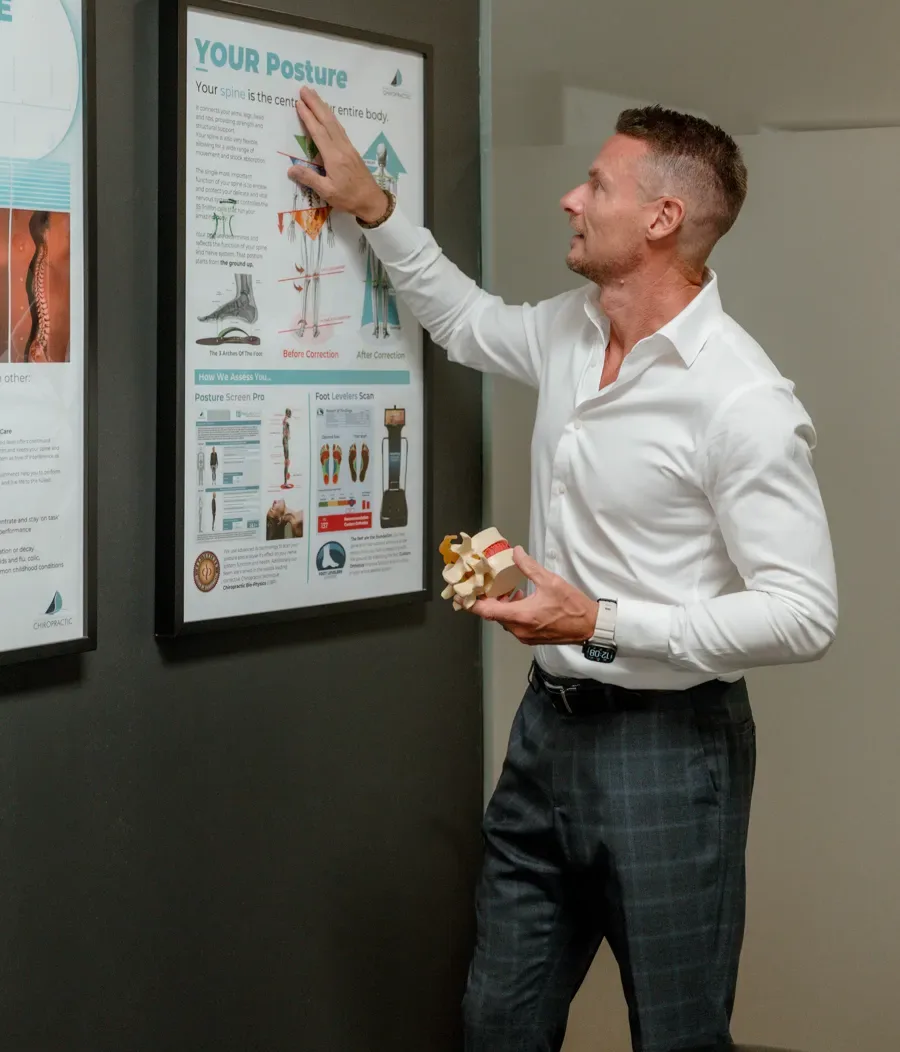
Short answer: These posture exercises target the muscles that hold your head, shoulders and upper back upright. Many people find they help counter long hours of sitting, screens and driving. In the video, our chiropractor demonstrates the routine. Do them slowly and little and often, rather than all at once.

These exercises are general guidance. Do them as directed by your chiropractor.
How to do these posture exercises
Follow along with the video. The written steps below cover the core moves.
- Chin tuck. Stand or sit tall. Gently draw your chin straight back without tipping your head down. Hold, then relax.
- Shoulder blade squeeze. Let your arms hang. Draw your shoulder blades back and slightly down, as if tucking them into your back pockets. Hold, then release.
- Wall angels. Stand with your back, bottom and head against a wall. Raise your arms into a "W" shape against the wall, then slowly slide them up and down, keeping contact where you can.
- Doorway chest stretch. Place your forearms on either side of a doorframe at shoulder height. Step one foot through until you feel a stretch across the front of your chest.
- Upper back extension. Sit in a chair with a firm backrest at about shoulder-blade height. Hands behind your head, gently lean back over the backrest, then return.
Sets, reps and holds
A good starting point is 10 slow repetitions of the chin tucks, squeezes and wall angels, holding each for 3 to 5 seconds. Hold the chest stretch for about 30 seconds. Once or twice a day is plenty, or as your chiropractor directs.
Getting it right
- Arching your lower back. Keep your ribs down and your tummy lightly braced.
- Shrugging. Shoulder blades go back and down, not up to your ears.
- Forcing the range. On wall angels, only go as high as you can while keeping good contact.
- Rushing. Slow, controlled reps do more than fast ones.
Exercise is one part of the picture. How you set up your desk, car and phone use matters too. Read spinal posture explained for the bigger picture.
It also helps to know that posture is run by your brain. It relies on a constant stream of information from sensors in the deep muscles of your spine, which is why chiropractors think of the spine as a sensory organ.1 Regular movement through the day keeps that information flowing. More in chiropractic and your nervous system.
When to stop
Stop if an exercise causes sharp pain, or pins and needles in your arms or hands. Tell your chiropractor at your next visit, or call us on 03 9787 8518.
References (1)
- Haavik H, et al. (2021). Contemporary model of vertebral column joint dysfunction. Eur J Appl Physiol. doi:10.1007/s00421-021-04727-z