Short answer: Spinal posture is the way your spine is shaped and held when you sit, stand and move. A healthy spine has three gentle curves: in at the neck, out at the upper back and in at the low back. Posture problems usually come from holding one position too long, not from one "wrong" shape.
What is spinal posture?
Spinal posture describes how the 24 movable vertebrae of your spine, plus the pelvis and skull, line up with each other. Seen from the side, a healthy spine isn't straight. It has three natural curves:
- Cervical lordosis: a gentle inward curve in the neck.
- Thoracic kyphosis: a gentle outward curve in the upper and mid back, where the ribs attach.
- Lumbar lordosis: an inward curve in the low back, sitting on top of the pelvis.
These curves work like a spring. They help spread load through the discs, joints and muscles, and they let your head sit balanced over your pelvis without your muscles working overtime. Seen from behind, the spine should look roughly straight, with level shoulders and hips.
Good spinal posture is not one perfect position
It's easy to think good posture means sitting bolt upright all day. That isn't how the body works. Your spine is designed to move, and the research suggests there isn't one ideal sitting or standing position that suits everybody.
What tends to cause trouble is staying in any position for a long time. Holding your head forward over a laptop for three hours, or slumping in the car for a long drive, keeps load on the same joints, discs and muscles. Over time, those tissues can get stiff, sore and sensitised.
So a more useful way to think about posture: your best posture is your next one. Change position often, and keep the curves roughly balanced rather than exaggerated or flattened.
Common spinal posture patterns
When we look at posture pictures, a few patterns come up again and again:
| Pattern | What it looks like | Common contributors |
|---|---|---|
| Forward head posture | Head sits in front of the shoulders, chin pokes out | Screens, phones, desk work, driving. See tech neck. |
| Rounded upper back | Increased curve in the upper back, shoulders rolled forward | Long hours sitting, weak upper back muscles |
| Flat back | Reduced curve in the low back, pelvis tucked under | Prolonged slumped sitting |
| Sway back | Hips pushed forward, upper body leaning back | Standing work, habitual "hanging" on ligaments |
| Side-to-side shift | One shoulder or hip higher, spine curves sideways | Carrying on one side, old injuries, leg or pelvis differences |
Having one of these patterns doesn't mean something is wrong. Plenty of people have them with no pain at all. They're useful clues about how your body is loading, especially when they line up with where you're sore.
Why spinal posture matters
Your head weighs roughly as much as a bowling ball. When it sits balanced over the spine, the neck muscles don't have to work hard. As it drifts forward, the muscles at the back of the neck and upper back work harder to hold it up. Many people with this pattern feel it as neck stiffness, upper back tightness or headaches that start at the base of the skull.
In the low back, long periods of slumped sitting flatten the natural curve and put more sustained load on the discs and the back of the spine. Many people notice this as low back stiffness when they first stand up.
Posture is also about how well your spine can move into and out of positions. A stiff upper back, for example, can push more movement onto the neck and low back. That's why we look at how your spine moves, not just how it looks standing still.
Spinal posture starts in the brain: proprioception and your body map
Posture isn't something you hold by willpower. Your brain runs it in the background all day, based on information from your body. The most important source is proprioception: your sense of where your body is and how it's moving, without having to look.
Your spine is one of the richest sources of that information. The small, deep muscles linking one vertebra to the next are packed with muscle spindles, tiny sensors that report length and movement to the brain. Researchers have called them the brain's eyes within the muscles. From that stream of data your brain builds, and constantly updates, an internal map of your body, then uses it to decide how hard each muscle should work to keep you upright and balanced.
When a spinal segment stops moving well, after an injury, a period of pain or long-term stress, that reporting can become patchy. With poorer information, the brain's map of the area can drift, and its control of the surrounding muscles can shift with it. Chiropractors call this a vertebral subluxation; researchers describe it as a change in how the brain controls a spinal segment.1
Research is exploring whether chiropractic care changes these sensory processes. In one 12-week trial of adults over 65, the chiropractic group improved ankle joint position sense, multisensory integration and stepping reaction time compared with a control group.2 That's one trial of sensory function, not evidence that posture itself changes. For more, see chiropractic and your nervous system.
How we approach this at MPCC
Every new patient appointment at MPCC includes posture pictures. They give you and us a clear, objective view of how you stand. Alongside that, we hear your story and do a thorough chiropractic, orthopaedic and neurological check of your spine, joints and nerves. The appointment takes 30 to 40 minutes.
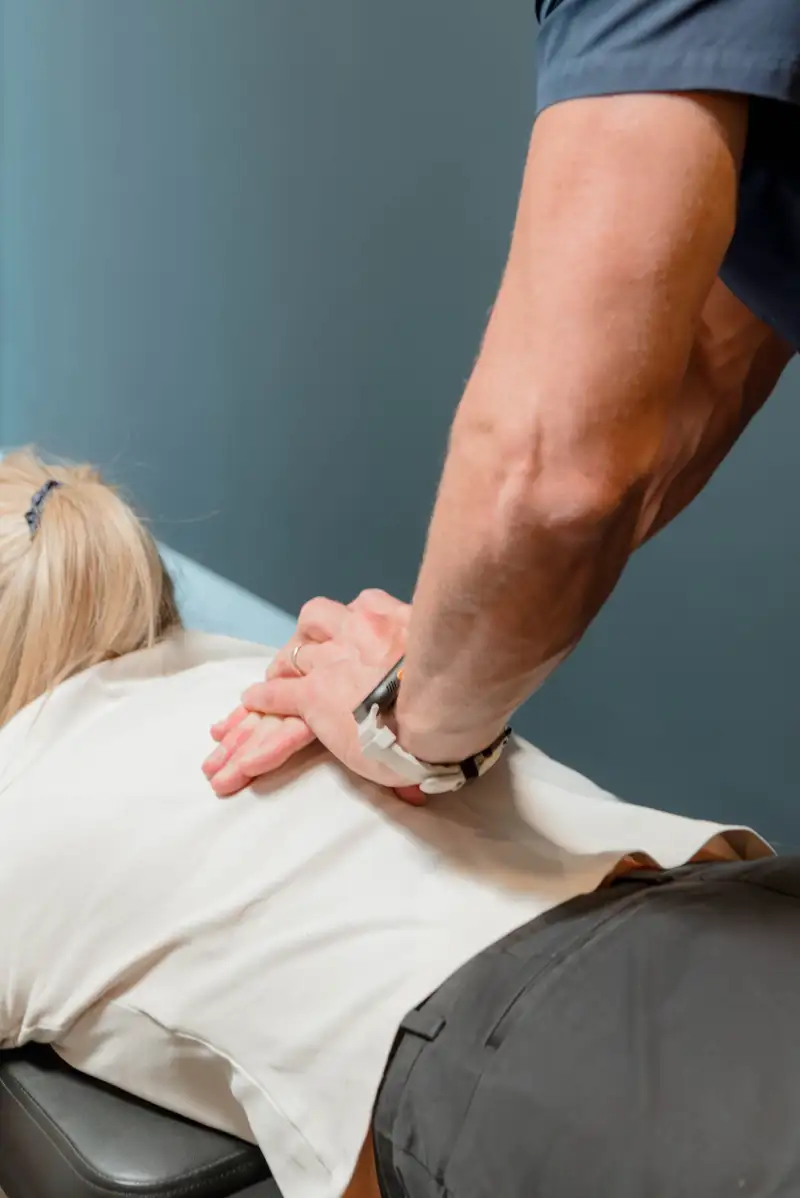
At your report of findings appointment we walk you through your posture pictures and what we found in plain English, and explain what we'd suggest. Care may include chiropractic adjustments for joints that aren't moving well, plus home exercises and practical changes to how you sit, work and sleep. Dr Ryan Tan has a particular interest in posture and spinal rehabilitation. See our poor posture page for more.
Simple ways to look after your spinal posture
- Move often. Set a reminder to stand up or change position every 30 to 45 minutes.
- Bring screens up. Raise your laptop or monitor so the top of the screen sits around eye level.
- Support your low back. A small rolled towel behind the low back can make long sitting easier.
- Strengthen the upper back. Simple rowing and shoulder-blade exercises help. Try our posture exercises.
- Share the load. Swap sides when carrying bags or kids.
References (2)
- Haavik H, et al. (2021). Contemporary model of vertebral column joint dysfunction. Eur J Appl Physiol. doi:10.1007/s00421-021-04727-z
- Holt KR, et al. (2016). Sensorimotor function and falls risk in older people after chiropractic care. J Manipulative Physiol Ther. doi:10.1016/j.jmpt.2016.02.003