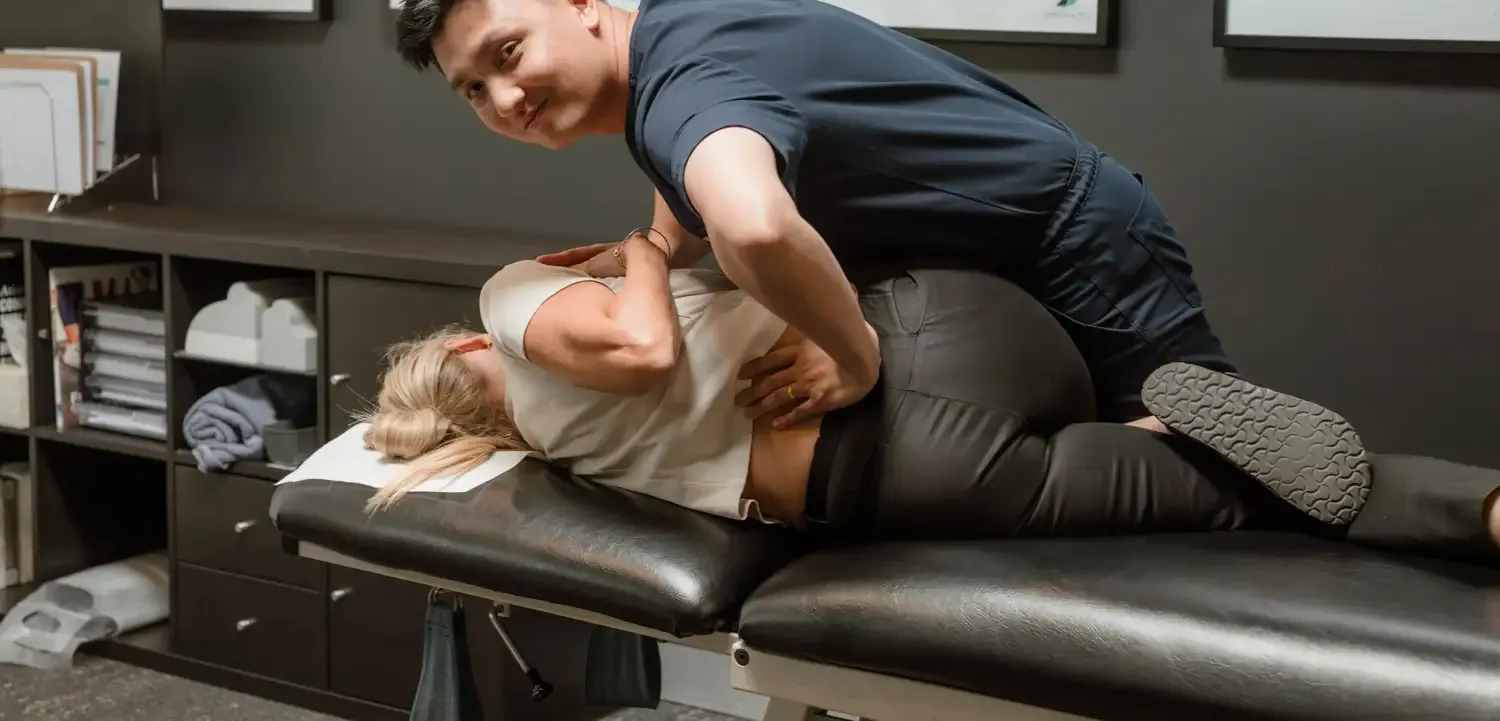
Short answer: A chiropractor leg pull is usually one of two things. Either your chiropractor is comparing your leg lengths as part of a check, or they're using a hip technique: holding your ankle and applying a steady pull, sometimes with a quick tug, to gently gap the hip joint. Neither one stretches your leg or changes its length.
Why do chiropractors pull your leg? Two different reasons
People use "leg pull" for two quite different things that happen on a chiropractic table. One is an assessment. The other is a technique. They look similar from the outside, which is where most of the confusion comes from.
- The leg check. You lie face down or on your back and your chiropractor lines up your heels to see whether one leg appears shorter than the other. Sometimes they bend your knees or turn your head and look again. It's one piece of information, not a diagnosis.
- The leg pull adjustment. You lie on your back, your chiropractor holds your leg just above the ankle, leans back to take up the slack, and may finish with a short, quick pull. This is a traction technique aimed mainly at the hip.
| Leg length check | Leg pull hip adjustment | |
|---|---|---|
| What it is | An assessment | A hands-on technique |
| What your chiropractor does | Compares where your heels line up | Holds your ankle and applies traction, sometimes with a quick tug |
| What you feel | Very little | A stretch through the hip and leg, sometimes a pop |
| Purpose | Gives a clue about pelvis and muscle tension | Aims to improve movement in a stiff hip |
| Changes leg length? | No | No |
The leg length check: what your chiropractor is looking at
When your heels don't line up, there are two broad explanations.
- A functional difference. The bones are the same length, but one leg looks shorter because of how your pelvis is sitting, tension in the muscles around your hip and low back, or the way your feet are loading. This kind of difference can change from one day to the next, and can change on the table as muscles relax.
- A structural (anatomical) difference. One thigh or shin bone is actually longer than the other. This doesn't change with chiropractic care. It can be measured more precisely, for example on X-ray, when it matters.
Small leg length differences are very common, and plenty of people with one have no pain at all. So a leg check on its own doesn't tell your chiropractor much. Research on visual leg checks also suggests they aren't very reliable as a stand-alone test, which is why a good chiropractor treats it as one clue among many. Your history, how you move, what your joints feel like and orthopaedic and neurological testing all count for more. We explain that process in how chiropractors know where to adjust.
Why a leg check can change: muscles, the pelvis and your nervous system
The tension in the muscles around your hips and low back isn't decided by those muscles alone. Your nervous system sets it, constantly adjusting muscle tone based on feedback from sensors in your joints and in the small, deep muscles of your spine. When a spinal segment isn't moving or being controlled well, researchers describe that feedback loop as disrupted, and the brain's control of the area changes1. Chiropractors see this as one reason a functional leg length difference can shift during a visit: muscle tone and the way the pelvis is held have changed, not the bones.
Research shows spinal adjustments reach the leg muscles through the nervous system. In a study of 25 people with recurring spinal problems, a single session of adjustments increased the strength of the muscles that lift the foot by 19% and recruited more of those muscles' higher-threshold motor units2. A leg check is one clue among many in a full assessment. More in chiropractic and your nervous system.
The leg pull hip adjustment: what's actually happening
The technique searchers call a "leg pull adjustment" or "leg pull hip adjustment" is usually called long-axis traction or distraction of the hip. Here's how it typically goes:
- You lie on your back, relaxed, with your leg straight or slightly turned in or out.
- Your chiropractor holds your leg just above the ankle and leans back, taking up the slack so you feel a gentle stretch from the hip down.
- They may hold that steady pull for a few seconds, or finish with a short, quick tug along the line of the leg.
- They recheck how the hip moves and how it feels.
The pull briefly gaps the ball and socket of the hip and stretches the joint capsule and the muscles around it. Sometimes this produces a pop. That sound is a gas bubble forming in the joint fluid as the pressure inside the joint drops. It isn't bones cracking and it isn't something going "back into place". It also isn't a sign of success: the joint can move better with or without the sound. If you want the detail, see what happens when a chiropractor cracks your back.
It should feel like a strong stretch, not pain. If it hurts, say so and your chiropractor will change what they're doing. Your history matters here too: things like a hip replacement, recent surgery or a recent injury change what's appropriate, and your chiropractor will check before using any traction technique. Many people with hip pain or SI joint pain find it comfortable, but it's always your call.
Short leg myths
- "The pull made my leg longer." It didn't. If your heels line up differently after an adjustment, that reflects a change in how your pelvis is sitting or how tight the surrounding muscles are, not bone length.
- "One short leg means my spine is crooked." Not necessarily. Many people have a small difference with a perfectly comfortable spine.
- "Every leg length difference needs correcting." Small differences are normal. Whether yours matters depends on the whole picture.
- "The louder the pop, the better it worked." The sound tells you a gas bubble formed. It says nothing about how useful the adjustment was.
- "A leg pull is a party trick." Done properly, it's a recognised hip traction technique chosen after a check, not a routine for everyone.
How we approach this at MPCC
At Mornington Peninsula Chiropractic, nothing happens to your hip, back or leg until we've checked you properly. Your first visit is a new patient appointment of 30 to 40 minutes. We hear your story, take digital posture pictures and do a thorough chiropractic, orthopaedic and neurological check of your spine, joints and nerves, including your hips and pelvis where they're relevant. If your history and check point to X-rays, we'll refer you, and the imaging clinic we refer to bulk bills X-rays our chiropractors request.
Whether you're adjusted on that first visit is up to the clinical judgement of your chiropractor. Often more testing comes first. At your report of findings appointment we explain what we found in plain English and what we'd suggest, including which techniques and why. If you'd rather not have a particular technique, tell us and we'll talk through other options.
New patient appointments are $125 when booked online through our website (usually $195; new practice members only, one per person). No referral needed.
References (2)
- Haavik H, et al. (2021). Contemporary model of vertebral column joint dysfunction. Eur J Appl Physiol. doi:10.1007/s00421-021-04727-z
- Niazi IK, et al. (2020). Spinal manipulation and tibialis anterior muscle properties. Healthcare. doi:10.3390/healthcare8040548