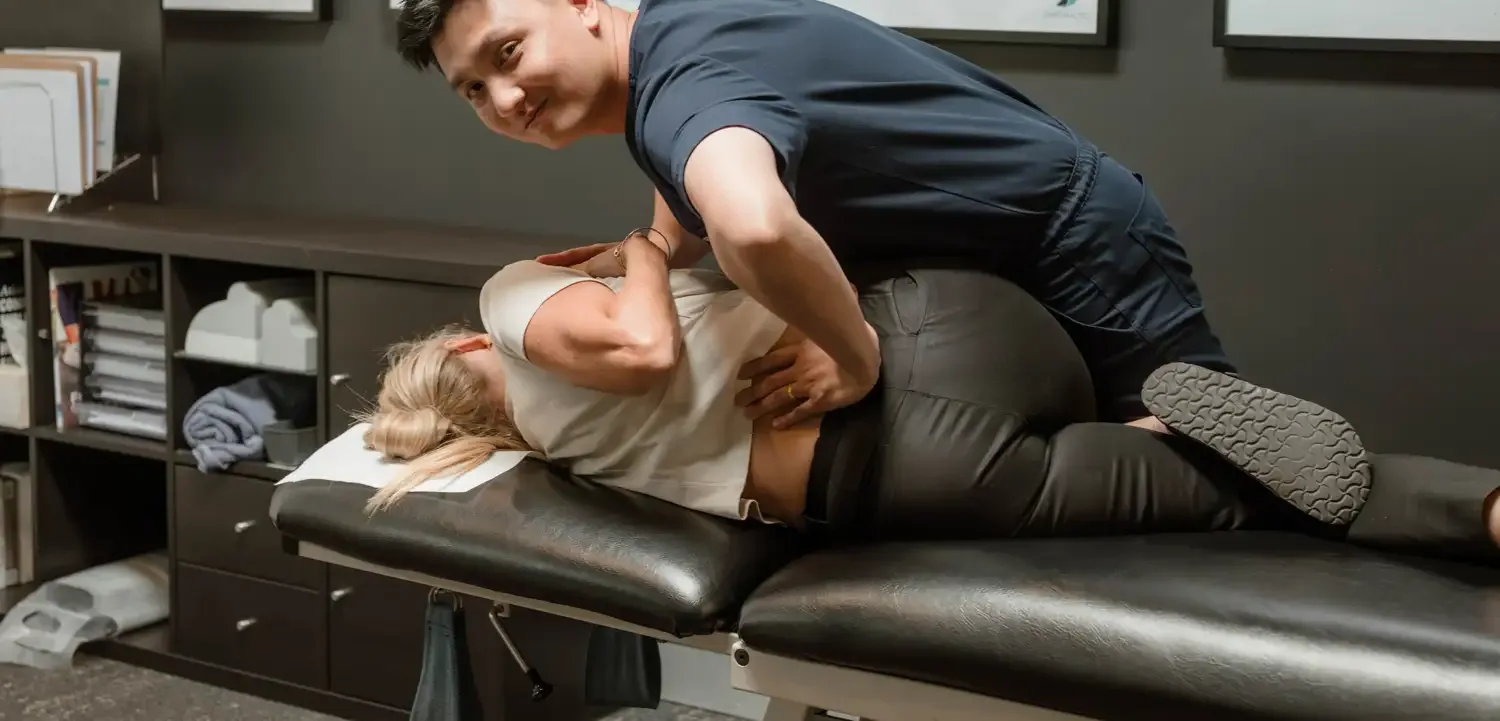
Short answer: Lower back pain can feel worse after a chiropractic adjustment, especially after your first few visits. It's usually mild soreness or stiffness, a bit like the ache after a new workout, and it generally settles within a day or two. If pain is clearly worse, not easing, or worries you, call your chiropractor.
Why your lower back can feel worse after an adjustment
Feeling sore after the chiropractor is one of the most common things people ask us about. It's understandable: you came in to feel better, and now your back aches. Here's what's usually going on.
- Stiff joints have moved. If part of your low back has been stiff or guarded, an adjustment moves it in a way it hasn't moved for a while. The surrounding tissues can react.
- Muscles are settling. Muscles that have been holding tight to protect a sore area can feel tender as they ease off.
- Your back is already irritated. If you came in during a flare, your back is sensitive. Almost anything, including hands-on care, can briefly stir it up.
- You did more afterwards. Many people feel looser and then do a big job in the garden or a long drive the same day. That often explains next-day soreness.
Soreness also tends to be more noticeable early on. As your back gets used to moving more freely, and as you get stronger with your home exercises, many people find the after-ache becomes milder or stops altogether. If it doesn't, that's worth raising with your chiropractor.
This kind of soreness is a common, temporary response. It doesn't mean something has been damaged. Equally, it isn't a sign that care is "working". It's just a normal after-effect for some people.
It also helps to know what an adjustment actually is. It isn't forcing a bone back into line. It's a quick, specific movement that sends a burst of sensory input from the deep muscles and joints of your low back to your brain, which researchers think helps the brain update how it controls that segment1. In one trial of 76 people with chronic low back pain, four weeks of chiropractic care was followed by measurable changes in resting brain activity, along with lower pain scores2. That research is still early, and it says nothing about next-day soreness either way. If you're curious, see chiropractic and your nervous system.
Sore after the chiropractor: what's normal and what isn't
| Usually normal | Call us to talk it through |
|---|---|
| A dull ache or stiffness in the area that was adjusted | Pain that is clearly worse than before your visit, not just sore |
| Soreness that starts within hours and eases over a day or two | Soreness that isn't easing after a couple of days |
| Feeling a bit tired that day | New pain spreading into the buttock or leg |
| A short flare of your familiar back pain | New pins and needles, numbness or weakness, or anything that worries you |
If anything in the right-hand column applies, or you're simply unsure, call the clinic on 03 9787 8518. We'd rather you rang than sat at home wondering. We can talk it through and, if needed, see you and check what's going on.
What to do if your lower back hurts after the chiropractor
- Keep moving gently. Short, easy walks usually help more than lying still. Avoid long stretches of slumped sitting.
- Use heat or ice. Whichever feels better, for 15–20 minutes at a time. Our guide to ice for back pain explains how.
- Go easy for the rest of the day. Hold off heavy lifting, big gym sessions and long drives until the soreness settles.
- Do your home exercises as shown. Gentle movements like lumbar mobilisations may help, but ease off anything that sharply increases your pain.
- Tell us at your next visit. How you felt after an adjustment is useful information. Your chiropractor can adjust the approach.
Can a chiropractor make back pain or a herniated disc worse?
This is a fair question and it deserves a straight answer. Any hands-on care can aggravate symptoms for a short time. Most of the time that's the temporary soreness described above. Lasting worsening is not common, but it's the reason a careful check matters before any adjustment, particularly if you have leg pain, a known disc problem or nerve symptoms.
Disc problems in the low back need a careful neurological check, testing sensation, reflexes and strength in the legs, and a technique that suits the person. For many people with disc bulges or sciatica, we use our flexion-distraction table: a gentle, rhythmic, table-assisted technique for low back and disc problems. Care is adapted to how your back responds, visit by visit.
How we approach this at MPCC
One of the simplest ways to reduce post-adjustment soreness is to understand your back before anything is done to it. Your first visit is a new patient appointment: 30–40 minutes covering your story, posture pictures, and a thorough chiropractic, orthopaedic and neurological check of your spine, joints and nerves. X-rays only when your history and check point to them.
At your report of findings appointment, we explain what we found in plain English, whether we can help, and what care would involve, including what you might feel afterwards. Whether you're adjusted on the first visit is up to the clinical judgement of your chiropractor. Care for low back pain may include specific adjustments, flexion-distraction work and exercises to take home.
We'll also ask how you felt after each visit. If you were sore, we may change the technique, the amount of force, or what we ask you to do at home. That feedback loop is a normal part of care, not a sign anything has gone wrong.
And if you're sore afterwards, call us. That's part of the service.
References (2)
- Haavik H, et al. (2021). Contemporary model of vertebral column joint dysfunction. Eur J Appl Physiol. doi:10.1007/s00421-021-04727-z
- Haavik H, et al. (2024). Neuroplastic responses to chiropractic care. Brain Sci. doi:10.3390/brainsci14111124